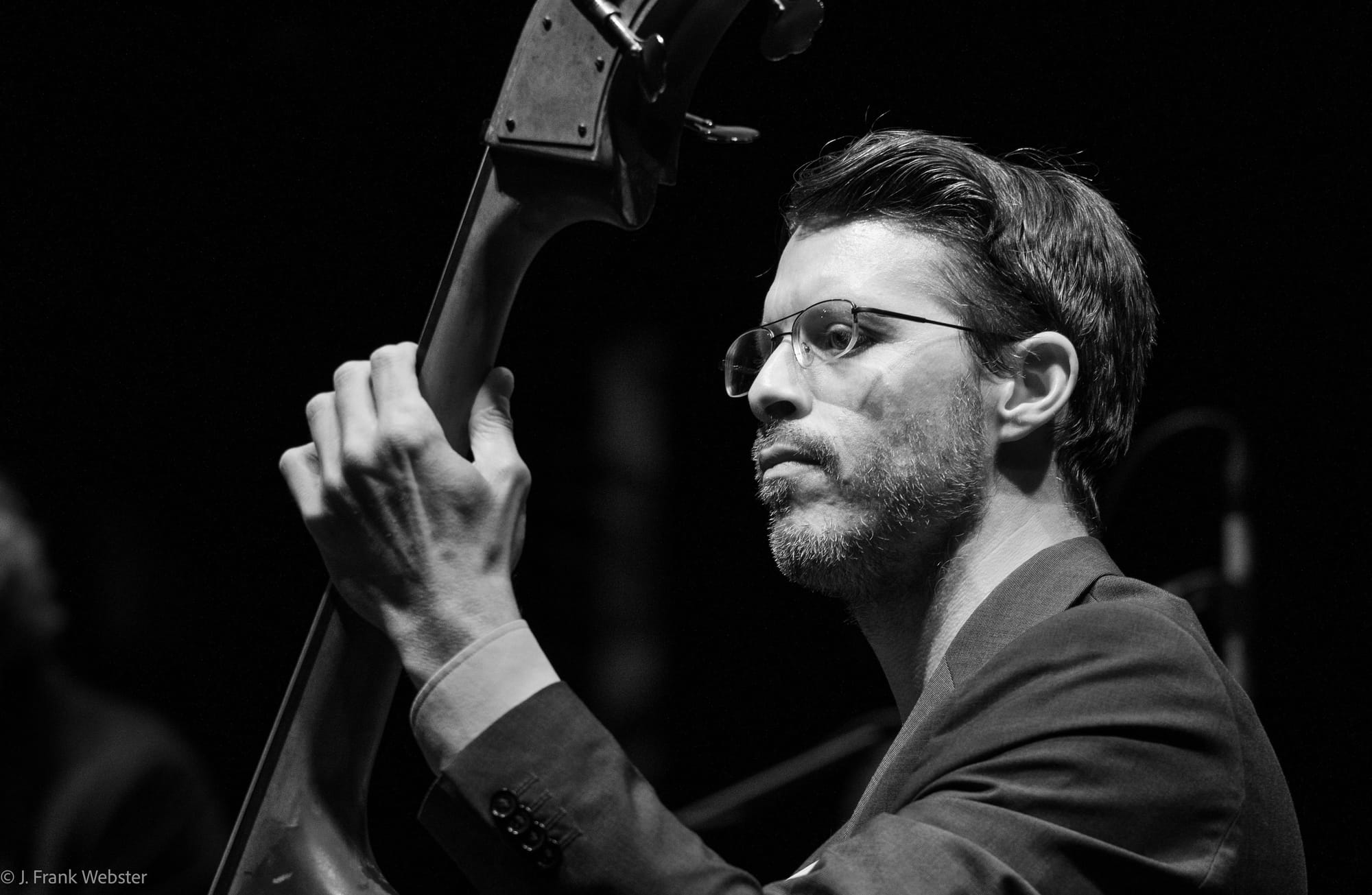
As any musician in any band will attest: "We're all following the bass player."
The audience doesn't know this, necessarily. In a younger band, perhaps the band members themselves won't admit it. But for experienced, seasoned veterans of the stage, the truth is self-evident. Everyone on that bandstand is listening to the bass. The drummer locks into it. The pianist voices chords around it. The horn players phrase against it. The singer, consciously or not, leans on it like a wall.
The bass player is the invisible architecture of the music.
The bass provides the foundation of the harmonic structure — the root of every chord, the anchor of every key change. Rhythmically, it serves as a tethering force, connecting the pulse of the drums with the melody and harmony of the rest of the ensemble. Remove the bass and the music doesn't just sound thin, it loses its gravity. It floats, unmoored, searching for something solid beneath it.
Yet no one in the audience really notices the bass player. That is, until there's a problem.
This is precisely the role of the CFO in a business.
The CFO, your books, and the cash flow disciplines behind the scenes, are the pulsing, low-end rhythm of the enterprise. When everything is locked in — when the cash is moving, the reports are clean, the forecasts are sound, the controls are working — no one notices. They just feel it. The company moves with confidence. Decisions get made without hesitation. The team knows there's a floor beneath them, even if they can't articulate why.
That feeling of organizational confidence? That's the bass pulsing.
The CEO — the lead singer — is out front, connecting with the audience. Vision, culture, narrative. Front and center under the lights. The Sales team is out there closing, pushing, drumming up the next opportunity. The top producer landing the marquee client? That's the lead guitarist taking a shredding solo, all fire and flash and well-deserved applause.
Nobody's looking at the bass player.
Nobody has to. When the bass is locked in, the whole band trusts it without a second thought. When cash controls are solid, the whole business runs on a kind of unspoken confidence. The CEO pitches investors. The sales team takes risks. The operators commit to growth. All of it resting on a foundation they rarely stop to examine.
Until something breaks.
I've been in the room when the bass dropped out.
Not on stage — though that has happened too, with consequences that were only embarrassing. In the boardroom. In the back office. In the moment when a CEO realizes the cash position they assumed existed does not, in fact, exist. When payroll is seventy-two hours away and the receivables report hasn't been reconciled in three weeks. When the line of credit is drawn down in ways no one thought to communicate upward.
Those moments are not subtle. Everyone feels it instantly. The room changes temperature. The confidence drains. Decisions that were easy the day before suddenly feel impossible, because no one can hear the bass anymore. The foundation is gone, and the music — the whole enterprise — starts to fall apart.
In music, when the bass player has a problem, the band has a problem. Every single person on that stage feels it, whether or not they can name what's wrong. The same is true in business. Cash flow is not a finance department concern. It is an everyone concern. The CFO is simply the one responsible for keeping that pulse steady, reliable, and felt.
There's a saying often attributed to the great vocalist, bandleader, and trumpeter Chet Baker: "It takes a good drummer to beat no drummer."
The implication, of course, is that there would still be a bassist. The drummer can be gone, and a great rhythm section can hold things together — but the bass is the last thing standing between music and chaos.
The CFO is that last thing standing.
Not because the role is more important than the CEO or the sales team or the operators who execute every day. Every part of the ensemble matters. Every voice in the band contributes to what the audience hears. But the foundation is the foundation. You can have a great band without a flashy lead guitarist. You cannot have a great band — or a great business — without something solid holding the bottom end.
So if you're a CEO, treat your CFO the way a great frontman treats a great bassist: with deep, quiet respect, and the wisdom to know that everything you do up front is made possible by what's being held together behind you.
The bass is always pulsing. Make sure yours never stops.