Most of us were taught that money is math. Add enough of it up, subtract your debts, and the number at the bottom of the page tells you how you're doing. Pass or fail. Rich or struggling. Winning or not.
I spent years on both sides of that ledger — first as a as a working musician doing the thing that most finance professionals would call the opposite of sensible. Playing gigs. Chasing sound. Investing in the intangible. Next, as a CFO managing multi-million dollar budgets, scrutinizing balance sheets until I knew the numbers (and what they meant) intimately.
What I discovered over more than two decades living in both worlds is this: money and music are not opposites. They are the same force, wearing different clothes.
"If you want to find the secrets of the universe, think in terms of energy, frequency, and vibration." — Nikola Tesla
Tesla wasn't writing a self-help book. He was describing the fundamental architecture of physical reality. Modern quantum physics has since validated what he intuited — that matter, at its most basic level, is not solid at all. It is energy, vibrating. Particles are probability waves. What feels permanent is, in fact, a pattern of motion.
If that is true of the universe, it is true of everything in it. Including money.
The physicist and the spiritual teacher agreed.
Decades after Tesla, Deepak Chopra arrived at the same place from a completely different direction:
"Money is life energy that we exchange and use as a result of the service we provide to the universe." — Deepak Chopra
Read that twice. Not "money is a medium of exchange." Not "money is a store of value." Money is life energy. It moves because you move it. It flows toward the service you provide. It is not a thing to be hoarded — it is a current, and like all currents, it responds to frequency.
In quantum physics parlance, it's both a wave and a particle. It's both an idea and something made manifest. Money, like other currents of human exchange, responds to human thought and the ways in which that thought becomes manifest.
Then there's author and philosopher Dan Millman, who brought the idea one step closer to home: money is a form of energy that tends to make us more of who we already are. A generous person with money becomes more generous. A fearful person with money becomes more fearful. The money doesn't change your character — it amplifies your vibration.
Tesla gave us the law. Chopra applied it to exchange. Millman applied it to character. Three minds, three disciplines, one conclusion: money is not separate from the physics of the universe. It is subject to the same rules as everything else — energy, frequency, vibration.
What every musician already knows
Here is something no finance textbook ever told me, but twenty-one years of performing did.
When you walk on stage, the room already has a frequency. The audience has a collective energy — nervous, expectant, distracted, open. Within the first thirty seconds of sound, something happens. Either the room meets you, or it doesn't, and it has almost nothing to do with how technically perfect you play. It has everything to do with what you bring to the stage — your intention, your presence, your vibration.
As the best-musician-you've-never-heard of, Austin's own Erik Hokkanen, taught me many years ago, "Kris, our job is to charge up the air." Wow. How profound to hear that at 25 years old. I think about this every day at work, whether I'm in the office, on a Zoom meeting, or on a stage (most often these days, at the Saxon Pub, one of the few places in Austin the remains mostly the same as it did when I moved here in 2005.)
If you play scared, then the room feels it. Play with abandon and joy, and the room follows you somewhere it didn't know it wanted to go.
I have watched this happen hundreds of times. I have felt it from the inside. And the more I studied finance — really studied it, not just the mechanics of debits and credits but the deeper patterns of why some organizations thrive and others collapse with identical resources — the more I recognized the same phenomenon.
Organizations that operate from scarcity, from fear, from a defensive crouch — they drain the energy from the room. Their numbers may look fine for a while, but something is always leaking. Organizations that operate from clarity, from genuine service, from a belief that there is enough — they seem to attract resources the way a great band attracts an audience. Through vibrational magnetism, without forcing it.
Your bank account is a tuning fork
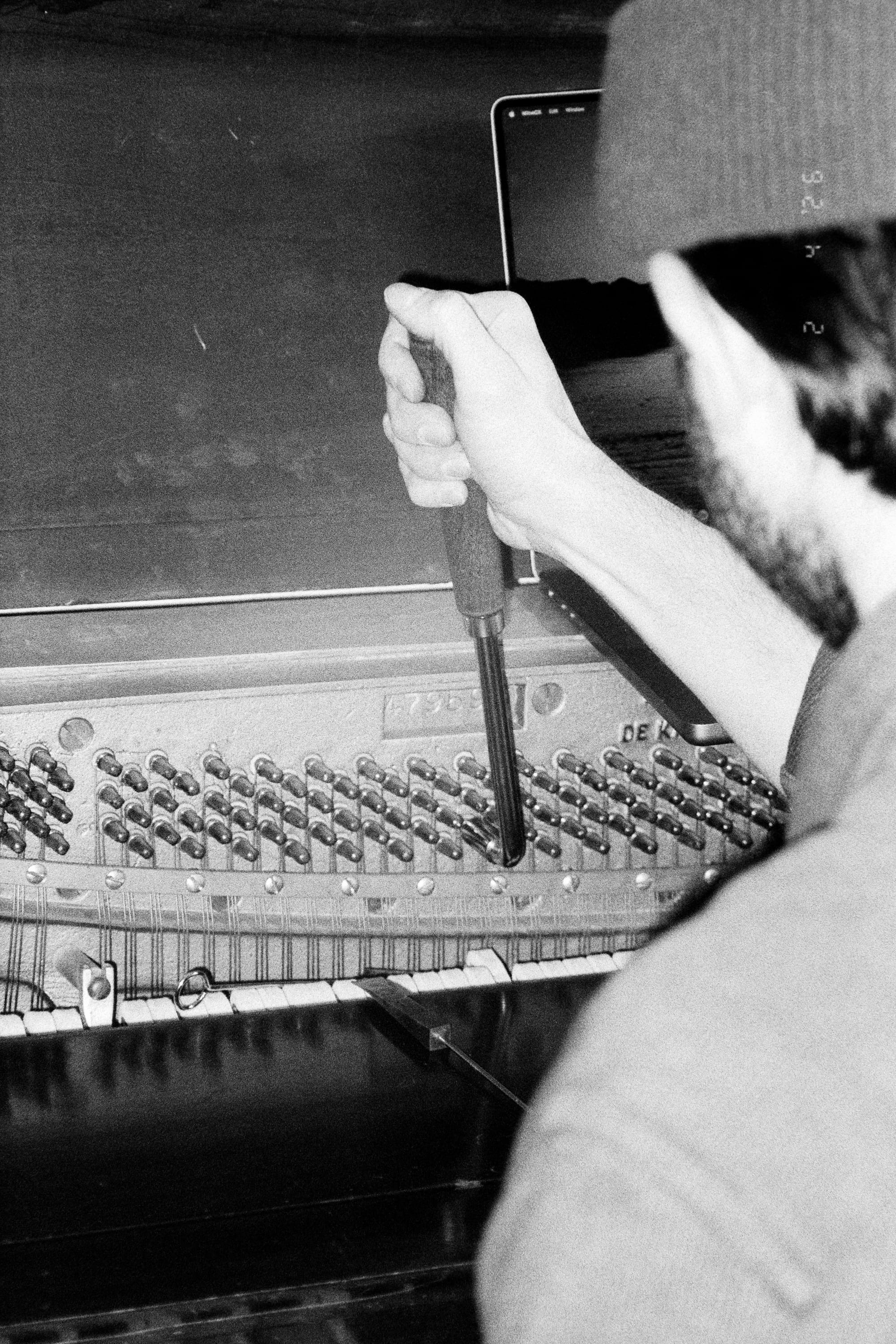
A tuning fork doesn't create sound on its own. It responds to the frequency it was built for. Strike it, and it rings at its natural pitch. Hold it next to another object tuned to the same frequency, and that object begins to vibrate too — without ever being touched. This is sympathetic resonance. It is one of the oldest and most beautiful phenomena in physics.
Your financial life works the same way.
The beliefs you carry about money — whether it is scarce or abundant, whether you deserve it or must fight for it, whether it flows or must be hoarded — those beliefs are a frequency. And the universe, as both Tesla and Chopra and every serious musician understands intuitively, echoes back what you're transmitting.
This is not mysticism for its own sake. This is not wishful thinking. As a CFO, I have watched the numbers long enough to see the pattern. The organizations and individuals who treat money as a resource to be circulated — who invest in people, in craft, in value creation — consistently outperform those who treat it as a finite pie to be protected. The frequency of abundance generates abundance. The frequency of scarcity generates scarcity.
Most of us were taught that money is math. But money is music first. It moves in rhythm. It responds to dynamics. It rewards those who learn to listen — and it rises when you finally stop playing scared.
This is the first post in an ongoing series exploring the intersection of financial intelligence and the deeper physics of value, creativity, and exchange. The Music of Money is built at the crossroads of two decades of professional performance and a career in financial leadership — because those two worlds have always been, at their core, the same conversation.